Edelson

Blog

Your blog category

BigPanda CEO executive portrait lit against the company logo in blue, photographed by Josh Edelson in Redwood City, California
Blog

How to Refresh Your Executive Team Headshots

BigPanda, an enterprise AI software company in Redwood City, needed to refresh the headshots on their executive leadership page. Their head of corporate marketing sent me a creative brief with a line I have thought about ever since: they wanted editorial confidence, not corporate compliance, and individual personality over a branded wall of blue button-downs. That is the clearest description I have read of what separates a good leadership page from a forgettable one. Here is how we shot it. The CEO portrait, lit in the company's own blue against their logo. (Photo by Josh Edelson for Big Panda) Building the CEO portrait out of a waiting room The CEO needed something distinct from the rest of the team, and the space I had to work with was an ordinary corporate waiting area. What it did have was the company logo on the wall. So I moved the furniture out of the way and set two lights with umbrellas. One went on the wall, aimed directly at the logo, gelled blue to match BigPanda’s brand color. The second lit the CEO himself, keeping him clean and separated from that blue field behind him. The result reads like a set built for the shot, not a lobby I rearranged twenty minutes earlier. That is usually the job: find the one usable element in an unremarkable room and build around it. Two looks for the CEO, one consistent look for the team For the CEO we shot two distinct looks: the blue logo portrait above, and a second setup matching the rest of the leadership team. The CEO’s photo works harder than anyone else’s. It runs next to funding announcements, in press kits, and on conference bios, so having both a branded signature image and a versatile standard one covers every use without a reshoot. The rest of the leadership team got one carefully consistent look. On a team page, consistency is the whole game: same light, same crop logic, same background treatment, so the grid reads as one company rather than a collection of individual photos taken in different decades. Shot outdoors in an open park area beside the office, background thrown fully out of focus. (Photo by Josh Edelson for Big Panda) Why the background is a blurred park, not a backdrop A seamless backdrop is the right call for a lot of corporate work. It was the wrong call here, because a gray sweep is exactly the compliance look the brief was pushing against. Next to the office there was an open park area with good separation between the subject position and the trees behind it. Shooting there, wide open, threw the background into soft color and light while keeping every portrait consistent with the others. The team reads as a group without looking stamped out of the same machine, and the images have air in them, which matters on a web page where the portraits sit in a grid. The same setup and light across the leadership team keeps the page consistent. (Photo by Josh Edelson for Big Panda) One consistent outdoor look across the leadership team. (Photo by Josh Edelson for Big Panda) How they found me One detail I like about this project: BigPanda found me by asking Claude for a photographer in Redwood City. An enterprise AI company discovered their photographer through an AI assistant. Their head of marketing mentioned it in the first email, and it is a small sign of how much has changed about the way companies find the people they hire. What this kind of shoot involves A leadership team refresh like this runs as a half day on location, about fifteen minutes per executive, timed around a day when the team is already together. I bring the full studio: lights, modifiers, backdrop options if we need them, and instant review so nobody leaves wondering how they looked. Delivery is a curated, retouched gallery, and selects can come back fast when a page relaunch is waiting on them. If your leadership page needs the same treatment, see executive headshots and portrait sessions or read the difference between a headshot session and an executive portrait session. For a full team, the corporate headshots page covers how headshot days work, and the headshot day planner gives you timing and pricing before you book. If your company is looking to refresh its corporate headshots, reach out for a quote! Tell me your team size and timeline and I will send pricing the same day: josh@edelsonphotography.com or 650-515-0999. You can also plan your shoot with the free headshot day planner. Frequently Asked Questions How long does an executive leadership team headshot session take? A leadership team refresh typically runs as a half day on location, about fifteen minutes per executive, scheduled around a day when the team is already together such as an offsite or board meeting. Should executive headshots use a backdrop or an environmental background? It depends on the look you want. A seamless backdrop gives a clean, formal, highly consistent result. An outdoor or environmental background thrown out of focus reads warmer and more editorial while still keeping the whole team consistent, which suits companies who want personality rather than a uniform corporate look. Should the CEO get a different headshot than the rest of the team? Often, yes. The CEO photo works harder than anyone else's: press releases, funding announcements, conference bios. A signature branded portrait plus a standard look matching the team covers every use. The rest of the leadership team benefits most from one carefully consistent look across the whole page. For a full breakdown of pricing, see what professional headshots cost in San Francisco.

A burned American flag rests atop a flagpole at a burned home during the Old Trails Fire in Spokane, Washington, August 4, 2026. (Josh Edelson / AFP)
Blog

The Old Trails Fire: 14 Hours in Spokane

See the full set: my complete Old Trails Fire take on Getty Images. I spent 14 hours on Monday photographing the Old Trails Fire in Spokane, Washington, on assignment for AFP. Three fires burning through Spokane County have destroyed more than 700 homes and displaced at least 65,000 people. After more than a decade covering California fires, this was my first major fire assignment in Washington, and it followed a pattern I know too well: the fire moves through, and then people come back to see what is left. Most of what I photographed was not flame. It was aftermath. A woman kneeling beside her dog. Families walking the footprint of a house and trying to match the debris to the rooms they remember. A couple holding hands in front of a home that is now a chimney and a car body. These are the hardest frames to make, and they are the reason I keep making them. Fire statistics do not move people. A person hugging her mother in the ash does. Kimber Renz hugs her mother Kristen Renz at her burned home during the Old Trails Fire in Spokane, Washington, August 4, 2026. (Josh Edelson / AFP) Shyla Zavala and Jin Brooks view their burned home during the Old Trails Fire in Spokane, Washington, August 4, 2026. (Josh Edelson / AFP) Some details stay with you. A burned American flag still hanging from its pole. A message spray painted on the street in front of a destroyed house, asking whether anyone had checked under the car for a missing pet, with the pet’s name and years written beside it. Whole blocks reduced to foundations while a house one street over stands untouched under a coat of pink retardant. Fire is not fair, and it is not finished: crews were still working lines outside the city while residents sifted lots inside it. A burned American flag rests atop a flagpole at a burned home during the Old Trails Fire in Spokane, Washington, August 4, 2026. (Josh Edelson / AFP) A note searching for a missing pet is painted on the street of a burned home during the Old Trails Fire in Spokane, Washington, August 4, 2026. (Josh Edelson / AFP) At a Red Cross evacuation center, people waited for news about homes they could not reach. That is the part of a fire the cameras usually leave before: the waiting. Sixty five thousand people in one county are doing some version of it right now. My wildfire archive from more than 100 fires across the West is in my California wildfire gallery, and comparable outtakes from my fire coverage are available to license directly for editorial and educational use. If you are covering the Northwest fires and need context imagery, reach out.

Matt Garman Amazon CEO executive portrait at Amazon Seattle headquarters, corporate photography by Josh Edelson
Blog

Headshot Session vs Executive Portrait Session: Which Do You Need?

Two of the most common requests I get from companies sound similar but are different products: “our team needs headshots” and “our CEO needs photos because press is starting to pick us up.” The first is a headshot session. The second is an executive portrait session. Here is the difference in plain language, and how to know which one you need. What a standard headshot session covers A headshot session produces one polished, consistent look. One background treatment, one outfit, a tight professional frame. It is the right product for LinkedIn profiles, team pages, internal directories, and most professional uses. For teams, it is priced by group size as a headshot day. For an individual, it is a short session with a handful of finished selects. What an executive portrait session covers An executive portrait session is built for range, not just polish. In roughly two hours we shoot 3 to 4 distinct looks across different backgrounds and settings, with multiple outfits, and I frame every look three ways: wide, medium, and tight. The deliverable is a press-ready image library, usually a few dozen finished files, that covers everything a communications team gets asked for. AWS CEO Matt Garman, photographed in Seattle. Two looks from the same session: an environmental portrait at Amazon headquarters, and a studio look on a plain background. One serves a magazine feature, the other a byline or board deck. Why the framing matrix matters Different outlets want different photos. LinkedIn and article bylines want a tight headshot. Conference organizers and podcast producers want a medium portrait with some breathing room for their graphics. Magazines and newspapers prefer wider environmental frames they can crop to their layout. If all you have is one tight headshot, every one of those requests becomes a scramble. With a portrait library, your team just picks the right file and hits send. When a CEO should upgrade The trigger is visibility. If your company is raising a round, launching publicly, hiring fast, or starting to appear in trade press, requests for photos of your leadership will arrive faster than you expect. That is the moment to build the library, before the profile piece, not the week the reporter asks. A funding announcement with a strong environmental portrait reads like a company on the way up. The same announcement with a stretched LinkedIn headshot does not. Time, deliverables, and price A standard individual headshot session is short and focused, and team headshot days are priced by group size, starting at $2,000 for a half day. An executive portrait session runs about two hours on site, covers 3 to 4 looks with multiple outfits, and delivers a finished library with wide, medium, and tight frames of each look. Executive portrait sessions are quoted to scope: locations, number of looks, and how the images will be used. Both happen at your office or a location of your choice, and I bring the full studio either way. Which one do you need? If the photos are for LinkedIn, the team page, or internal use: a headshot session. If the photos are for press, speaking, fundraising, a board announcement, or a CEO who is becoming the public face of the company: an executive portrait session. If you are not sure, tell me what the photos need to do over the next twelve months and I will tell you honestly which one fits. For team pricing, see what headshot photography costs. If your company is looking to refresh its corporate headshots, reach out for a quote! Tell me your team size and timeline and I will send pricing the same day: josh@edelsonphotography.com or 650-515-0999. You can also plan your shoot with the free headshot day planner. Real examples of both: an executive portrait session for a billion-dollar startup CEO and a leadership team headshot refresh. Frequently Asked Questions What is the difference between a headshot session and an executive portrait session? A headshot session produces one polished look for LinkedIn and team pages. An executive portrait session is a roughly two hour shoot producing 3 to 4 looks with multiple outfits, each framed wide, medium, and tight, resulting in a press-ready image library for media, speaking, and investor use. How much does an executive portrait session cost? Executive portrait sessions are quoted individually based on scope, locations, and how the images will be used. Standard team headshot days start at $2,000 for a half day. When should a CEO book an executive portrait session? When visibility is rising: a funding round, a public launch, growing trade press coverage, or a speaking calendar. Build the image library before the requests arrive, not the week a reporter asks.

On-location team headshot, San Francisco
Blog

Do You Need a Makeup Artist for Corporate Headshots?

One of the most common questions I get when a company books a headshot day: should we bring in a hair and makeup artist? The honest answer is that it depends on the shoot, and after photographing headshot days for teams from three people to three hundred, I can tell you exactly when it is worth it. Natural, matte, and consistent: what good hair and makeup preparation looks like on camera. (Photo by Josh Edelson) What a Makeup Artist Actually Fixes This is not about making anyone look made up. On a corporate shoot, a hair and makeup artist solves four specific problems that show up in almost every session. Shine. Studio strobes bounce off skin, and by mid-morning most faces have enough shine on the forehead and nose to catch the light. A makeup artist keeps everyone matte, which reads as polished and rested on camera. Hair. Most people do a quick pass in the mirror and call it done, and the camera disagrees. Flyaways, uneven parts, and collar-flattened hair are the small things people notice in their own photo and ask to reshoot. An artist catches them in thirty seconds, before the first frame. Consistency across the team. When forty people cycle through a headshot day, an artist gives every single person the same finishing pass. The result is a team page with one coherent tone instead of a mix of camera-ready and just-walked-in. For brands that care about a consistent look and feel, this is the quiet ingredient. Fewer retouching compromises. Small blemishes, dry patches, and redness can be handled in retouching, but heavy retouching starts to look like retouching. Fixing skin in person keeps the final images natural, because the correction happened in front of the lens instead of in software. Studio lighting finds every reflective surface, which is why matte beats glossy on a headshot day. (Photo by Josh Edelson) When I Recommend It Executive portraits and leadership headshots, almost always: these images live on press releases and investor pages, and they get scrutinized. Large headshot days, strongly recommended: the consistency benefit grows with every person. Any shoot that doubles as video day: video is far less forgiving of shine than stills. And brand or website revamp shoots where the whole company will sit side by side on one page. When You Can Skip It Small sessions with a natural, editorial look in mind often do fine without one. I carry blotting papers and a small finishing kit, I check hair and collars before every frame, and my retouching handles the rest. If the budget forces a choice between a makeup artist and more shooting time, I will usually tell you to take the shooting time. For current day rates, see what headshot photography costs in San Francisco. For executive portraits that will run in press and annual reports, a makeup artist is usually worth it. (Photo by Josh Edelson) How It Works With Me I work with trusted hair and makeup artists in the Bay Area and can add one to any quote, including multi-office programs in other cities. On the day, the artist works a few minutes ahead of me so the line keeps moving and nobody waits. If you are planning a team headshot day, the free headshot day planner maps out timing with and without an artist, or just start at the headshots page. If your company is looking to refresh its corporate headshots, reach out for a quote! Tell me your team size and timeline and I will send pricing the same day: josh@edelsonphotography.com or 650-515-0999. You can also plan your shoot with the free headshot day planner.

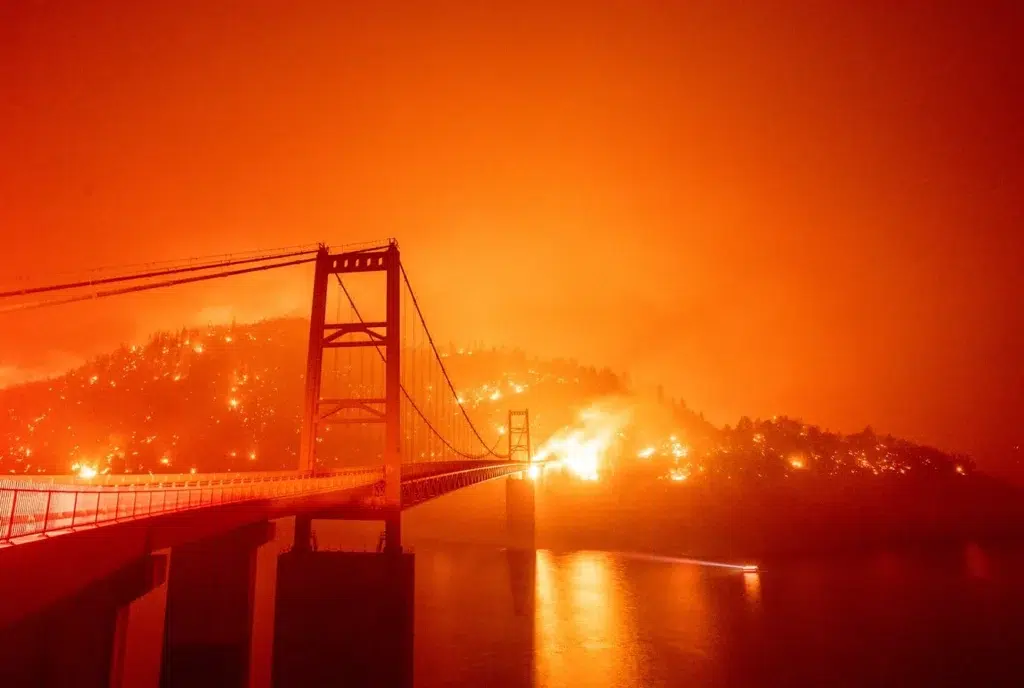
Terrifying footage shows California wildfire burning beneath bridge, photo by Josh Edelson/AFP
Blog

Watching Europe Burn: Notes From a California Wildfire Photographer

Right now there are major wildfires burning across France, Spain, and Italy. I have spent more than a decade photographing California’s biggest fires for AFP, over 100 of them, and watching the coverage out of Europe this week feels like looking at photographs I have already taken. The Bear Fire burns around the Bidwell Bar Bridge near Oroville, California, in September 2020. (Josh Edelson / AFP) Why Europe’s Fires Look So Familiar The scenes coming out of Europe follow a pattern I know frame by frame. Fires moving faster than the models predicted. Crews making stands at the edges of towns. Residents standing in the road, watching a column of smoke build over places that were never supposed to burn like this. California went through this realization years ago. The Camp Fire in 2018 erased a town of 26,000 people in a morning. The Dixie Fire in 2021 burned for three months and took the town of Greenville with it. In January 2025 I photographed urban neighborhoods in Los Angeles burning in the middle of winter. Every one of those fires broke an assumption about what fire could do. Europe is having its assumptions broken now. What a Decade Inside the Fire Line Teaches You I work in full firefighter Nomex with a fire shelter and a chainsaw in my truck, and I am self-contained for up to three days on a fire. The thing that scares me most is not the flames. It is the burned trees that keep smoldering at the roots and fall without warning, sometimes weeks after the front has passed. Firefighters call them widowmakers. A fire crew makes a stand as flames tear through brush in Northern California. (Josh Edelson / AFP) The other thing you learn is that the story is no longer about one fire and one town. Smoke from these events crosses oceans. Insurance markets move. Building codes change. Nowhere is fully protected anymore, and that is exactly why the images matter. A photograph of a firefighter silhouetted against a wall of flame communicates the scale of this change faster than any chart. Why This Is a Global Story Now For years, California was the cautionary tale. Now the same fire behavior is showing up in the Mediterranean, in Canada, in Chile, in Greece. The fire seasons are longer, the fuels are drier, and the overlap between wildland and neighborhoods keeps growing. The photographers covering France, Spain, and Italy this week are documenting the same new fire age I have been photographing in California since 2012, and their images will do the same work: making an abstract crisis impossible to look away from. A firefighter rescues an American flag as smoke turns the sky orange at the Wall Fire near Oroville, California, in 2017. (Josh Edelson / AFP) If You Are Covering This Story Newsrooms, educators, and documentary teams covering the European fires often need California imagery for context: what a decade of escalating fire looks like, from the first megafires to urban conflagration. My published wildfire frames are distributed by AFP and Getty Images, and I keep the copyright on comparable outtakes from the same fires, which I license directly at rates about 20 percent below the major agencies. You can see the work in my California wildfire gallery and get an instant estimate on the licensing page. I also speak about this work: what it is like to document the climate crisis from inside the fire line, and what these images do to the people who see them. If your conference or organization is talking about wildfire risk this year, get in touch.

A firefighting helicopter crosses in front of the sun at the Little Fire in Pleasanton, California, photographed on assignment for AFP by Josh Edelson
Blog

How I Photographed a Helicopter Crossing the Sun

Yesterday I shot the Little Fire in Pleasanton, California, on assignment for Agence France-Presse. It was my first fire of the season, and the best frame of the day took about three dozen attempts and nearly cost me my eyesight. A helicopter crosses the sun at the Little Fire in Pleasanton, California. (Josh Edelson / AFP) I Almost Did Not Go Before I drive to a fire I run the same set of calculations every time: weather, wind, topography, fuel, humidity, time of day, fire danger indices. That math tells me whether there will be anything left to photograph by the time I arrive. For the Little Fire, the answer was probably not. My read was that it would be laying down by the time I got there. I went anyway, for two reasons. Reason One: You Do Not Want Your First Fire of the Season to Be a Big One Peak fire season in California is close, and it has been a while since I have been in the field on an active wildfire. Fire coverage is a gear-heavy, physically demanding, situationally dangerous kind of shooting, and the muscle memory fades. Where you park. How you position relative to the wind. What you carry and what you leave. How you read a crew boss body language to know when a spot is about to become a bad idea. A small, slow fire is the right place to rebuild all of that. You do not want to be relearning it when the fire is running. A hand crew works a ridgeline in the late light at the Little Fire. (Josh Edelson / AFP) Reason Two: I Wanted to Field Test the AI System I Built All that pre-fire research used to take me a long time. Over the past several months I built an AI system to automate it, and wired it into Telegram so it reaches me on my phone in the field. It pulls the weather and wind, the terrain and fuel conditions, the fire danger picture, and gives me a read on whether a fire is worth the drive. The Little Fire was its first real test. It told me the fire would most likely be slowing down by the time I arrived. It was exactly right. Worth being precise about what it does, because it matters: the system helps me decide where to be and when. It does not take pictures. Every frame here is mine, made with a camera, in the smoke. What the AI bought me was a better decision about whether to get in the truck. What I Found, and How I Made Something of It The prediction was correct, which meant I arrived to a slow, smoky hill. No wall of flame, no dramatic run. Just haze and heat and a lot of distance between me and anything happening. This is the ordinary condition of this work. Most fires are not the picture you imagined on the drive. So you look harder. What I noticed was a steady stream of helicopters running water drops, and their flight line was carrying them near the sun. That is a picture, if you can time it. I put the 600mm on, framed the sun, and waited. Then I shot a few dozen frames staring more or less directly into it, which is exactly as pleasant as it sounds. Somewhere in there a helicopter crossed the disc cleanly and I got the frame at the top of this post. I love it. An air tanker lays a line of retardant along a ridge at the Little Fire. (Josh Edelson / AFP) Almost everything else came on the same long lens. Air tankers laying retardant, helicopters on water drops, and a hand crew reduced to small silhouettes walking a ridgeline in that heavy orange light. When the fire is far away and the air is full of smoke, a 600mm and patience are most of the job. A helicopter makes a water drop as the light goes orange through the smoke. (Josh Edelson / AFP) Not Peak Action, and Still Worth It This was not a big fire and these are not the most dramatic fire pictures I have ever made. But the gear is dusted off, the instincts are back, the new system proved itself on its first outing, and I came home with a frame I genuinely love. For the week before peak season, that is a good day. I have covered wildfires for AFP for years, including the work that has been exhibited at Visa pour l’Image and recognized by the Istanbul Photo Awards and the AFP Varenne/Canon Grand Prix. Fire season is nearly here again. Frequently Asked Questions How do you photograph a helicopter crossing the sun? A long lens, correct exposure for the sun rather than the scene, and patience. I used a 600mm, framed the sun, and waited for the aircraft flight line to carry a helicopter across the disc. It took roughly three dozen attempts. Never look directly at the sun through an optical viewfinder for longer than you must, and take breaks. What lens do you use for wildfire photography? On this fire, almost everything was shot on a 600mm, because the fire activity was far away and access was limited. Fire coverage generally runs long, both for safety and because the meaningful subjects, aircraft and crews, are usually at distance. Do you use AI to make your photographs? No. I built an AI system to automate the research I do before a fire, including weather, wind, topography, fuel and fire danger, and it messages me on Telegram in the field. It helps me decide whether and where to go. The photographs are made with a camera, by me. Need a photographer who works well under pressure? I shoot corporate events, conferences and executive portraits across the Bay Area and nationwide. Get in touch.

Booksmith owner Christin Evans photographed through the pages of a magazine at her San Francisco bookstore for the LA Times, by Josh Edelson
Blog

How I Shot an LA Times Portrait Through a Magazine

The LA Times sent me to photograph Christin Evans, who owns The Booksmith on Haight Street in San Francisco, for a story on how rising health premiums are squeezing small businesses. Her staff’s premiums jumped 17 percent this year. A bookstore is a gift of a location. Books floor to ceiling, warm light, color everywhere. I shot the clean environmental portrait first, Christin seated among the shelves, and I had a solid, publishable frame in the bag. But the safe shot and the memorable shot are rarely the same thing. The story was about words and numbers, premiums, costs, and fine print, and I was standing in a room made entirely of pages. So I pulled a copy of the New Yorker off a shelf, wrapped it around the front of my lens, and held it there with a rubber band. Then I shot Christin straight through the tunnel of open pages. The printed text blurs into a swirl around the frame, she stays sharp in the center, and the whole portrait gets framed by the exact thing the scene is built on: words on a page. That is the frame the LA Times ran, as the lead image. You can read the story here. Fifteen years shooting for the wire taught me the shot nobody else walked away with is usually the one worth chasing. Sometimes you build it out of whatever is on the shelf, a magazine and a rubber band included. Related: The portrait that keeps getting licensed.

San Francisco corporate photographer Josh Edelson, headshots, events, and aerial photography
Blog

How Much Does It Cost to License a News Photo? (Real Rates)

News and editorial images from my archive, all available to license. The short answer A single editorial image starts around $300. A single commercial image starts around $700. That is the floor. From there the price moves based on how you use it. I license direct, so you skip the agency markup. My rates run about 20 percent below what Getty and the big stock houses charge for the same kind of image. Here is what actually moves the number. Editorial or commercial: the biggest lever The first thing I need to know is what the image is for. Editorial use means news, education, documentary. A story about wildfires. A textbook. A museum panel. That is the lower tier, and it starts around $300 for one image. Commercial use means marketing, advertising, promotion. Anything selling a product, a service, or a brand. That starts around $700 for one image, and it climbs from there. Same photo. Different price. You are paying for the use, not the file. Placement, reach, and duration Once we know editorial or commercial, three things scale the price up. Placement (where it runs): web is the base, print costs more, broadcast and advertising placements cost the most. Reach (how many people see it): local is the base, national costs more, worldwide costs the most. Duration (how long you hold the license): one year is the base, three years costs more, perpetuity (forever) costs the most. Stack those together and you get your number. A small local web use for one year sits near the floor. A national print campaign running three years sits well above it. Exclusivity Want to be the only one using the image? That roughly doubles the price. Exclusivity means I pull it off the market for everyone else for the term you buy. That has real value if the image is tied to your brand or your campaign, and you pay for that value. Most people do not need it. If you are running a news story or an internal deck, a standard non-exclusive license does the job and costs less. A quick example Say a regional magazine wants one of my wildfire frames for a print feature. Editorial use, print, national reach, one year. You start at the $300 editorial floor and step up a bit for the print run and the national reach. You are still in the low hundreds, not the thousands. Now flip it. A company wants that same frame for a national ad campaign, print and web, running three years, and they want it exclusive. Commercial use, multiple placements, national reach, three years, plus exclusivity. That one climbs into four figures, and the exclusivity roughly doubles wherever the base lands. Same photographer, same file. The whole gap between those two numbers is use. What you actually get You get a written license that spells out how you can use the image: the placement, the reach, the term, and whether it is exclusive. Nothing hidden, nothing vague. If your use changes later, you extend or upgrade the license instead of starting over. You are never guessing about what you are allowed to do. A note on news photos and outtakes A lot of my news work runs through the wire, meaning AFP and Getty. When you see one of my wildfire frames in the New York Times or moving on the wire, the agency holds the rights to that exact published frame. You license that one through them. Here is what most people miss. I keep my outtakes. On any assignment I shoot far more than the one or two frames that get published, and a lot of those extra frames are just as strong. So if you want a comparable image from the same assignment, the same fire, the same event, the same subject, I can license that to you directly. You get the shot you need, you deal with one person, and you usually pay less than you would going through an agency. What it costs for your specific use Every use is a little different, so I built a tool that does the math for you. You pick the use type, the placement, the reach, and the duration, and it gives you a real number on the spot. No back and forth, no waiting on a quote by email. Get your number now: use the instant quote calculator on my License an Image page. Frequently asked questions How much does it cost to license a news photo? A single editorial image starts around $300 and a single commercial image starts around $700. The final price depends on the use type, where it runs, how far it reaches, how long you hold the license, and whether you want exclusivity. What is the difference between an editorial and a commercial license? Editorial covers news, education, and documentary use and starts around $300 for one image. Commercial covers marketing, advertising, and promotion and starts around $700. It is the same photo at a different price, set by how you use it. Does exclusivity cost extra? Yes. Exclusivity roughly doubles the price because the image gets pulled off the market for everyone else during your license term. Most editorial and internal uses do not need it and cost less without it. Can I license one of your photos that was published by AFP or Getty? The exact published frame is held by the wire agency, so you license that one through them. But I keep my outtakes from the same assignment and can license a comparable image directly, often for less than the agency charges. Related: The portrait that keeps getting licensed.

FBI SWAT team and armored vehicle as a suspect surrenders with his hands up during a federal raid, by Josh Edelson
Blog

How I Photographed an FBI Raid

“If they start shooting, stay right here, behind the engine block.” That was the first thing my FBI liaison told me once we were in position. Not the door, not the wheel. The engine block, because it is the one part of a car a bullet will not punch through. Anywhere else, he said, a round can skip off the pavement and find you. Neither of us was wearing a vest. This group, he told me, is known to be violent, and there was a real chance shots would be fired. I met him at 5:30 in the morning. By 6 we had joined the joint task force convoy and caravanned to a quiet gated neighborhood, the kind with a park in the middle and bikes in the driveways. We set up across the street, and we waited. A man watches from an upstairs window as the operation begins. (California Post) When it started, it came fast. SWAT moved in, threw a flash-bang, and called for the men inside to come out with their hands up. One of them peered through the window and saw what was waiting: a wall of law enforcement, rifles raised. A second flash-bang. A flash-bang detonates as the SWAT team moves in. (California Post) Then one by one they stepped out with their hands up, were told to walk backward toward the agents, and were handcuffed on the lawn. A suspect steps out with his hands raised. (California Post) Agents lead a suspect toward the armored vehicle as his family watches from the doorway. (California Post) It was not only the men. One of the suspects had a wife who stood holding their two small children wrapped in a blanket, watching as her husband was arrested. Later, the children watched too. Those are the frames that stay with you. A mother and her children watch as a suspect is handcuffed on the porch. (California Post) Five men were arrested and processed. They are accused of belonging to a large international crime ring tied to assassinations, contract killings, drug and gun trafficking, and extortion. The raid was one piece of a coordinated operation that struck at the same hour across California, Indiana, India, and Canada. Five men sit handcuffed on the ground after the raid. (California Post) FBI Gang Task Force officers process the scene. (California Post) I shot the whole thing on assignment for the California Post, from across the street with a 300mm 2.8 and a 70-200, close enough to read faces, far enough to stay out of the way. One of the more surreal mornings I have had behind a camera, and not one I will forget. A note on the images: to protect their identity, I blurred the faces of some of the officers in these photographs.

The diamond ring effect during a total solar eclipse, photographed by Josh Edelson
Blog

How to Photograph a Total Solar Eclipse

Update, August 2026: the total solar eclipse crosses Greenland, Iceland, and northern Spain on August 12, and it is now days away. If you are traveling for it, this guide covers everything below. If you read this after the 12th, everything here applies to every future eclipse too. I’ve chased two total solar eclipses. Weiser, Idaho in 2017. Bloomington, Indiana in 2024. Both times I was on a day rate for AFP, standing in a field full of strangers watching the sky go dark in the middle of the afternoon. My photos from those two eclipses ran on BBC, Yahoo, and Sky at Night Magazine, and Forbes featured my work too. That’s not a brag, it’s context: everything below is what actually worked for me on assignment, not theory I picked up from a forum. On August 12, 2026, another total solar eclipse crosses the Arctic, Greenland, Iceland, and Spain. Search interest in “how to photograph a total solar eclipse” spikes hard before every one of these events, and for good reason. You get one shot at it, it moves fast, and there’s a real safety rule you cannot break. Here’s how I plan for it, what’s in my bag, and how I handle the two or three minutes that actually matter. The sun’s corona blazing around the moon during totality. Where to Stand: The Path of Totality The August 12, 2026 total solar eclipse: the band of totality and the wider partial eclipse region. Graphic: European Space Agency (ESA), CC BY-SA 3.0 IGO. Totality only happens inside a narrow band on the Earth’s surface called the path of totality. One mile outside that path and you get a deep partial eclipse, which still looks like broad daylight. No corona, no darkness, none of it. You have to be inside the path. For the August 2026 eclipse, that path runs through Greenland, Iceland, and northern Spain, with the sun sitting low in the sky by the time it reaches Spain. Low sun angle changes your composition options, so factor that into scouting, not just the date. Once I know the path, I look at historical cloud cover data for that region and that time of year. Clear sky odds matter more than a scenic backdrop. I’d rather stand in a boring parking lot under a clear sky than a beautiful mountain ridge under clouds. I also build in mobility. If the forecast shifts two days out, I want the option to drive two or three hours to a clearer patch of sky without missing my slot in the path. Scout your spot in person if you can, or at least on satellite view. Know your foreground, know what’s blocking your horizon, and know where the sun will actually sit in the frame at the moment of totality. A sequence composite tracking the moon across the sun, from first contact through totality. The Gear I Actually Bring A telephoto lens. 400mm minimum, 600mm or longer if you can get it, for tight shots of the corona and prominences. A sturdy tripod. You’re tracking a moving target for over an hour of partial phases plus the main event. A cheap tripod will drift and cost you frames. A certified solar filter that fits the front of your lens, rated ISO 12312-2, for every partial phase shot. A second camera. I run one body on the long lens locked on the sun, and a second camera on a separate tripod for wide shots, the landscape, the crowd, or the selfie. An intervalometer or remote shutter so I’m not touching the camera and shaking the frame during totality. Extra batteries and cards. Cold weather and pure adrenaline both burn through batteries faster than you expect. The One Rule You Cannot Break Never point your eyes or your camera at the sun during any partial phase without a proper certified solar filter. Not for a second, not “just to check focus.” A few seconds of unfiltered sun through a lens can damage your eyes or your sensor. The only time the filter comes off is during totality itself, when the moon fully covers the sun’s disc. The instant totality ends and the first sliver of sun reappears on the other side, the filter goes back on immediately. That’s the whole rule. Get comfortable with it before eclipse day so you’re not thinking about it under pressure. I’ll admit I broke my own prep rule once. I showed up without my solar filter. I ended up taping together a pair of the free paper eclipse glasses everyone was handing out and holding that over my lens for the partial phases. It worked well enough to get usable frames, but it was not a plan, it was a scramble. Pack a spare filter. Check your bag the night before, not the morning of. The filter I improvised from taped paper eclipse glasses after forgetting my real one. Camera Settings and Bracketing Shoot manual the entire time. Auto exposure will fight you as the light swings from full daylight to near darkness and back in under an hour. Partial phases, filter on: Start around ISO 100, f/8 to f/11, and test your shutter speed on the actual sun through your actual filter before eclipse day. Filter density varies, so there’s no universal number. You’re looking for a clean, properly exposed disc with no blown highlights. Totality, filter off: The corona spans a huge range of brightness from the inner ring to the faint outer streamers, so one exposure will never capture all of it. Bracket hard, from roughly 1/2000 of a second up to a full second at the same ISO and aperture. If your camera has auto exposure bracketing, set it to fire through that whole range automatically. If not, cycle through shutter speeds manually every few seconds. Diamond ring and Baily’s beads: These happen in the last ten to fifteen seconds before totality and the first few seconds after. Keep your filter on until the